Guides · Reading the light
Sunset in Santorini, Month by Month
Sunset in Santorini ranges from about 17:05 in December to about 20:40 in late June. Golden hour begins roughly an hour before. If you are planning a ceremony or dinner around it, work backwards from your month's sunset time and give yourself a comfortable margin — the exact minute shifts a little every day.
- Earliest sunset
- About 17:05, early December
- Latest sunset
- About 20:40, late June
- Golden hour
- Roughly the last hour before
- Direction
- West, over the caldera
- Clocks change
- Late March · late October
- Rule of thumb
- Ceremony 1.5–2 h before sunset
What time is sunset in Santorini?
The island's whole evening economy runs on one number, and it moves by three and a half hours across the year. The table below gives the approximate range for each month — the first figure is roughly the start of the month, the second the end. Treat them as planning values: approximate, as of 2026 — verify the exact minute closer to your date, because it shifts a little every day and the clock changes in spring and autumn jump it by a full hour overnight.
| Month | Sunset (approx.) | Worth knowing |
|---|---|---|
| January | 17:20–17:50 | Short days; the light turns gold by mid-afternoon |
| February | 17:50–18:15 | Days lengthening fast |
| March | 18:15–19:40 | Clocks go forward in late March — sunset jumps an hour later |
| April | 19:40–20:05 | Proper evening sunsets return |
| May | 20:05–20:30 | Long golden evenings begin |
| June | 20:30–20:40 | The latest sunsets of the year |
| July | 20:40–20:20 | Barely shorter than June |
| August | 20:20–19:45 | Losing roughly a minute a day |
| September | 19:45–19:05 | Sunset meets the dinner hour |
| October | 19:05–17:25 | Clocks go back in late October — sunset jumps an hour earlier |
| November | 17:20–17:05 | Early, gentle sunsets |
| December | 17:00–17:15 | The earliest of the year, around the second week |
What is golden hour, and why does everyone chase it?
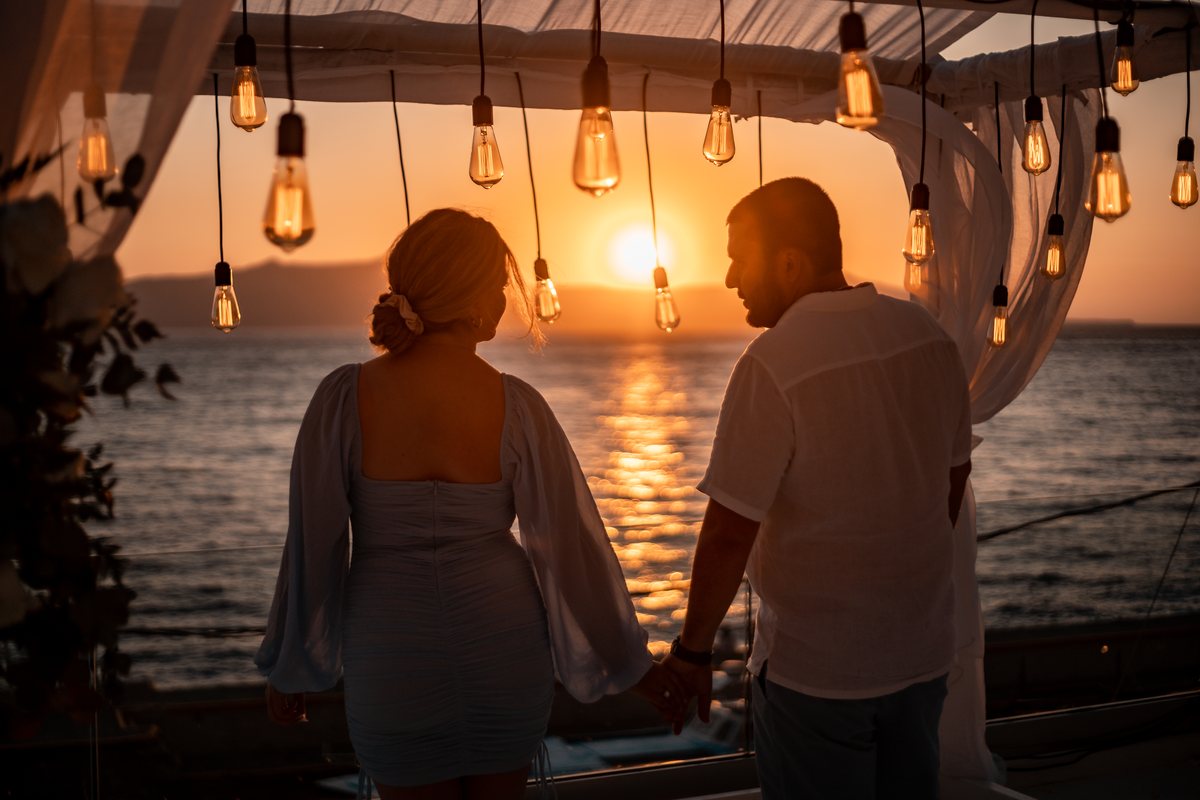
Golden hour is the stretch — roughly the last hour before sunset, a little longer in winter — when the sun sits low enough that its light travels through far more atmosphere, arriving warm, soft and flattering. Santorini is unusually good at it for a simple geographic reason: the caldera faces west over open water, so nothing interrupts the light between the horizon and your face. The whitewashed architecture acts as a giant natural reflector, bouncing soft fill light into shadows that would elsewhere go dark. Photographers plan whole itineraries around this hour; we walk through how to use it in the golden-hour photography guide.
And when the sun is gone, do not pack up: blue hour follows — twenty to thirty minutes of deep indigo sky with the caldera lights coming on — and many couples' favourite frames come from it.
How reliable are these times — and how fast does it get dark?
Very reliable, with two honest asterisks. The times drift by roughly a minute a day as the seasons turn, which the ranges above absorb — but the clock changes in late March and late October move sunset by a full hour overnight, so a wedding booked near those weekends should double-check which side of the change it falls on. There is also good news unique to sea-horizon islands: because Santorini's sun lands on open water, the listed time is genuinely when it disappears — no mountain range swallows it twenty minutes early, as happens in so many destinations.
After the sun goes, you have more evening than you might expect. Civil twilight — the stretch when the sky still glows and nobody needs a lamp — lasts roughly another twenty-five to thirty minutes here, shading into the deep indigos photographers call blue hour. Practically: if sunset is at 20:00, the terrace stays softly lit until about 20:30, candles take over by 20:45, and full night belongs to the stars.
Where should you watch it from?
Anywhere on the caldera side works; the arguments are about height and company. The rim villages watch from two or three hundred metres up, which gives scale — and, at the famous viewpoints in season, a shoulder-to-shoulder crowd that assembles an hour early. Down at the waterline the sun does something the clifftops never see: it meets the horizon at eye level and lays a path of light across the caldera straight toward you. That is the view our own terrace was built around — ΑΙΩΝ sits close to sea level on the caldera side of Fira, facing the sunset line with nothing between the table and the horizon — and it is why we tell couples to trust the table over the viewpoint. The sun performs everywhere; a chair, a glass and no crowd is the civilised seat for it.
How do you plan a ceremony around the sunset?
Work backwards. The reliable pattern is to begin the ceremony ninety minutes to two hours before sunset: vows happen in bright but softening light, congratulations and a toast follow, and the whole of golden hour is left free for photographs before the main event on the horizon. In June that means a ceremony around 18:45; in early October, around 17:10; in December, closer to 15:30. Couples who schedule the ceremony at sunset itself almost always regret it — the light is gone before the portraits begin.
Build in margin. Hair runs late, transport takes longer than maps promise, and the sun does not wait. A fifteen-minute buffer at every step costs nothing and saves the entire plan. If you are proposing rather than marrying, the same arithmetic applies tighter still — a sunset proposal wants you in position while the light is still golden, not scrambling as it drops.
How do you plan dinner around the sunset?
The most beautiful timing we know: sit down as the sun touches the sea. The sky then performs its entire slow fade — gold, rose, violet, indigo — across your first course and into the second, and candlelight takes over exactly when it should. In June that is a fashionably late dinner starting around 20:30; in September a civilised 19:15; and in winter an early, deeply romantic table from about 17:15, with the longest candlelit evening of any season stretching ahead of it. The full choreography of a romantic sunset dinner — courses, toasts, timing — is a guide of its own.
Which months give the most comfortable sunset evenings?
For sitting outdoors through sunset and beyond, the kindest months are late May to June and September to early October: warm air, manageable wind, and sunset late enough to follow a full afternoon but early enough that dinner does not become midnight. July and August work beautifully too, with two caveats — heat that lingers into the evening and the meltemi wind at its strongest. From November to March the sunsets themselves are often the year's most dramatic, painted on bigger, wilder skies; you simply dress for the temperature and dine earlier. How this trade-off plays across the calendar — sea, crowds, prices, light — is the whole subject of our best-month guide.
One last honest note: no evening is guaranteed. A rare summer haze or winter front can mute the show, and nothing on this island can be done about it. What you can control is position — an unobstructed west-facing seat — and timing. Get those two right and Santorini does the rest more often than almost anywhere on earth.