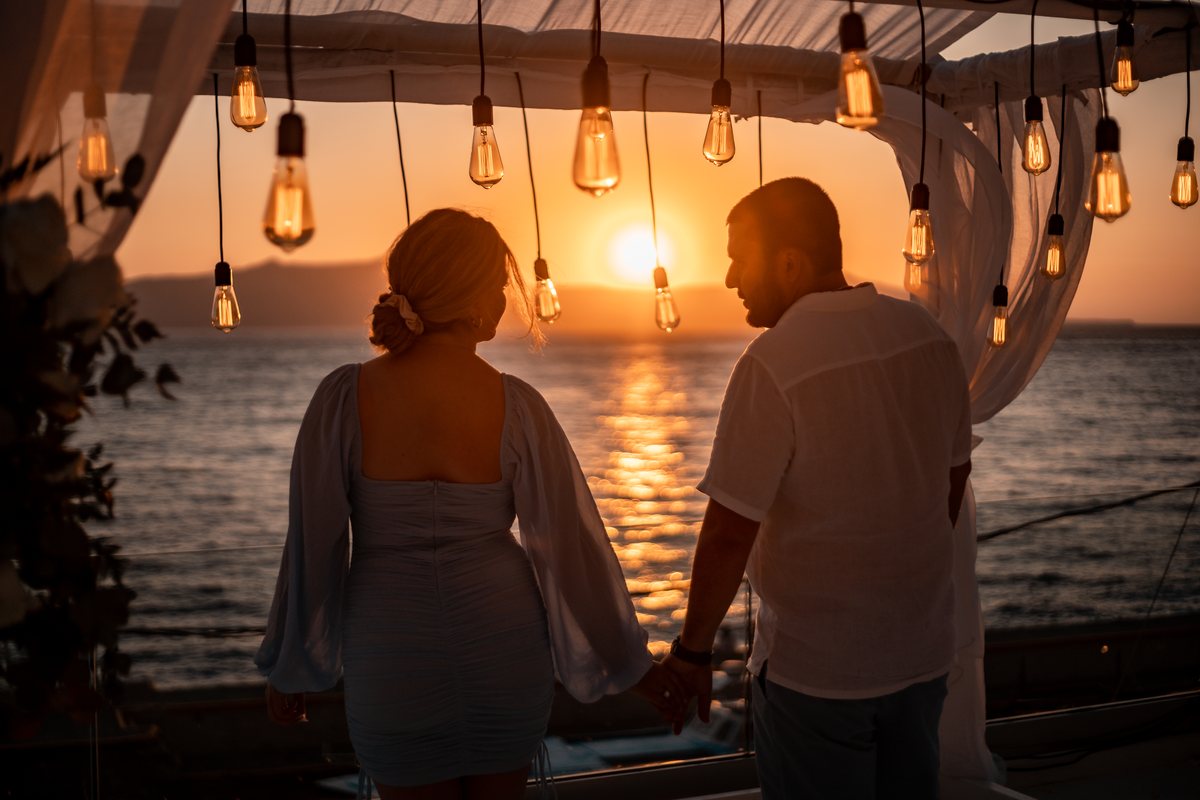
Guides · The shape of the day
Your Wedding Day, Hour by Hour
Work backwards from sunset. Set the ceremony ninety minutes to two hours before it, keep golden hour free for photographs, and sit down to dinner as the sun touches the sea. Everything earlier — preparation, first look, guest arrivals — hangs off that one anchor, which is why your month sets your whole schedule.
- The anchor
- Sunset — everything hangs off it
- Ceremony
- 1.5–2 hours before sunset
- Golden hour
- The last hour — keep it free
- Venue time
- 1, 2 or 3-hour rentals
- Dinner
- Starts as the sun meets the sea
- Buffers
- Fifteen minutes, everywhere
How do you build a wedding-day timeline around sunset?
Every good Santorini timeline is built the same way: find your month's sunset time, plant the ceremony ninety minutes to two hours before it, and let the rest of the day fall into place on either side. The sample below is anchored to a June evening with sunset at about 20:35 — the year's most generous light. The skeleton stays identical in any month; only the clock times slide, which is why the first thing to open when planning is the month-by-month sunset table.
An intimate venue changes the arithmetic in your favour. With no cocktail-hour crowd management, no receiving lines and no room flips for two hundred, an evening for two to thirty people needs less time and delivers more of it back to you. Here is what a full version looks like.
Two structural choices shape everything downstream. A first look — seeing each other privately before the ceremony — front-loads the emotion and buys the evening back: without one, all the couple portraits must squeeze into golden hour alongside everything else. And where you get ready matters more than couples expect: a preparation suite twenty minutes from the venue quietly costs forty minutes of margin across the day. Decide both early, and the table below nearly writes itself.
What does the day look like, hour by hour?
| Time | What happens | Why then |
|---|---|---|
| 14:00 | Hair, make-up, a slow start | The day's pace is set here — unhurried |
| 16:30 | Photographer joins preparations | Detail shots: dress, rings, letters, hands |
| 17:30 | First look | A private reveal, before anyone else sees you |
| 18:15 | Travel to the venue | Fira's lanes take longer than maps promise — buffer it |
| 18:45 | Guests arrive; welcome drinks | Cold glasses, warm light, seats with a view |
| 19:00 | Ceremony | Roughly 90 minutes before sunset; bright light, softening |
| 19:30 | Congratulations and a toast | Champagne while the sky begins to turn |
| 19:45 | Golden-hour portraits | The hour photographers cross oceans for |
| 20:35 | Sunset | Stop. Watch it. This is why you came |
| 20:45 | Dinner at one long table | The sky fades through your first two courses |
| 21:45 | Toasts and cake | Candlelight has taken over by now |
| 22:15 | Stars, last drinks, slow goodbyes | The caldera goes quiet; the sky fills up |
How does this map onto venue rental hours?
At ΑΙΩΝ the terrace rents by the hour in three packages — one, two or three hours — so you book the slice of that table you actually need. One hour covers the heart of it: a vow exchange or proposal, a toast, the sunset itself. Two hours adds the golden-hour portraits and local wine as the sky turns — a complete elopement evening. Three hours is the full arc above: ceremony under the arch, the reception dinner at one long table, and the stars arriving before the goodbyes. Whichever length you choose, the anchor stays the same — position your booked hours so that sunset falls inside them, about two-thirds of the way through.
How does the timeline change by season?
The skeleton never changes; the clock does. In June and July (sunset around 20:30–20:40) the day runs late and luxurious, exactly as tabled above. In September (sunset around 19:20) shift everything roughly seventy-five minutes earlier: ceremony at 17:45, dinner at 19:30. In October, once the clocks go back, the whole evening compresses — ceremony near 16:00, dinner by 17:45, and the reward is the longest candlelit stretch of the year. In deep winter (sunset just after 17:00) the day flips its proportions: a leisurely morning, a 15:30 ceremony, golden light by 16:15, and dinner that starts at dusk and simply keeps going. None of these is worse; they are different films cut from the same script.
What do real evenings here look like?
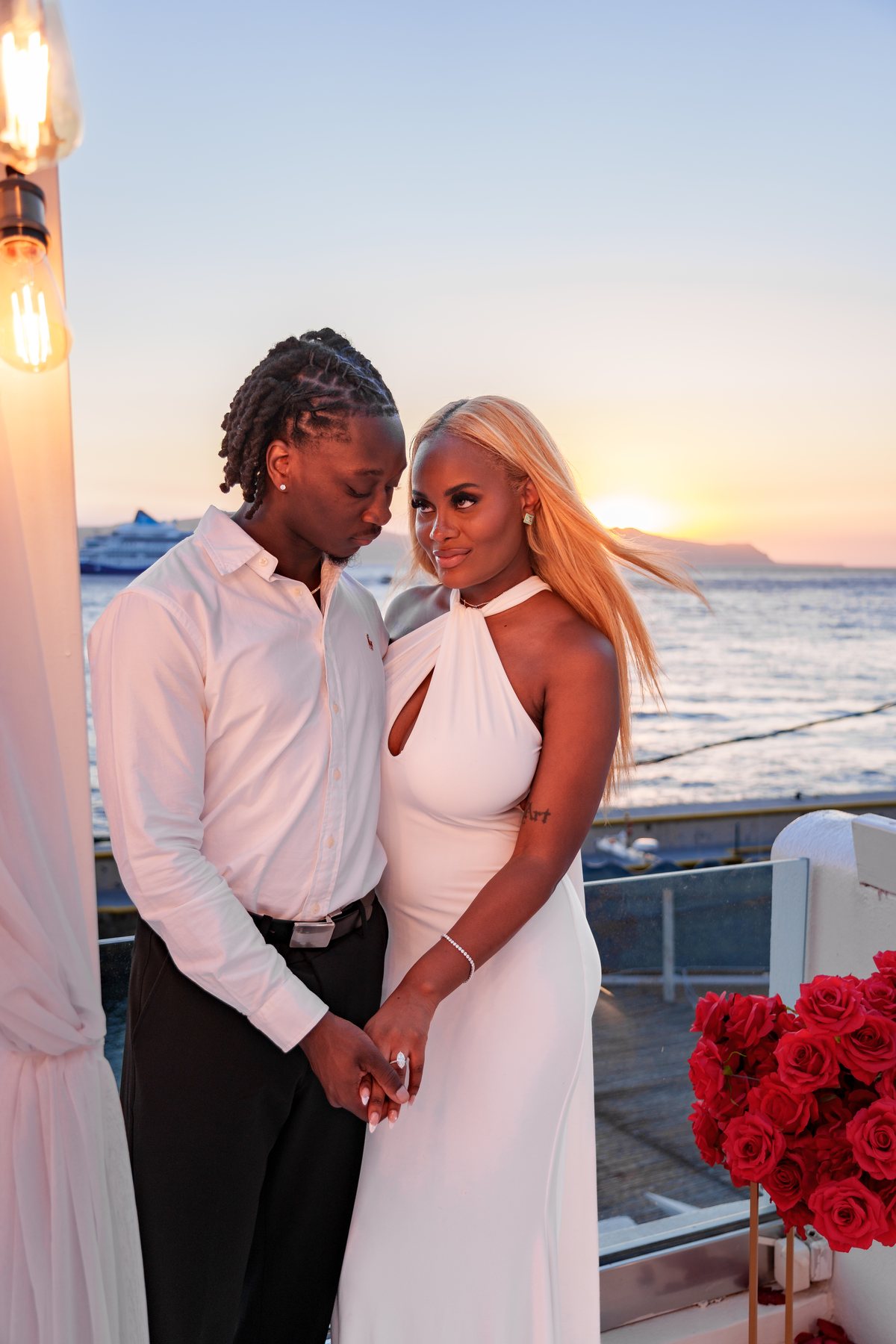
This is not theory — it is the shape most evenings on our terrace naturally take. Grace and Brennan's wedding followed it almost exactly: ceremony in bright light, the congratulations spilling into golden hour, portraits along the caldera as the colour deepened, then dinner as the sky performed its slow fade behind the volcano. The photographs tell the timeline better than any table can — you can watch the light change frame by frame through the evening.
How do proposals and private dinners compress the day?
Not every evening on a terrace is a wedding, and the shorter formats borrow the same skeleton with fewer bones. A proposal evening is the wedding timeline's final third: arrive inside golden hour, question and yes about forty-five minutes before sunset, a toast and a short shoot in the best light, then dinner as the sun lands — ninety unforgettable minutes, door to dessert; keeping it secret until that minute is the subject of the surprise-proposal guide. A private dinner is simpler still: seated a few minutes before sunset, the sky as the floor show, the courses pacing the fade. The discipline is identical at every scale — one anchor, worked backwards, with buffers — which is why couples who plan a proposal well tend to plan their wedding timeline well two years later.
Who actually keeps the timeline on the day?
Not you — that is the entire point of writing one. For a full wedding we genuinely recommend hiring a planner: coordinating the photographer, music, flowers and timings while the day is happening is a real job, and the trusted local planners we work with do it every week of the season. Our own staff are on the terrace throughout and keep the venue side moving — the table, the toasts, the lighting as dusk comes down — and for elopements, proposals and private dinners that is usually all the stage management an evening needs. The couple's only timeline duty is the one nobody can delegate: when the sun starts down, stop and watch it.
Which timeline mistakes should you avoid?
Six, all common, all preventable. Scheduling the ceremony at sunset — the single most frequent error; your vows get the spectacle, your portraits get darkness. Skipping buffers — fifteen unclaimed minutes at each step is the cheapest insurance in weddings. Booking speeches into golden hour — toasts are beautiful by candlelight and expensive in the best light of the day; let the photographs have that hour. Ignoring the forecast — a breezy afternoon may argue for vows twenty minutes earlier or a veil rethink; our honest guide to the wind covers it. And overfilling the schedule — the best moments on this island are the unplanned ten minutes when you simply stand at the rail and watch; leave room for them. Last, leaving the sunset unwatched — it sounds impossible, but couples mid-photo-list manage it every week. Whatever the schedule says, the two of you at the rail for the final minute is the timeline's true deliverable.